
Windows Under Siege: Record Number of Vulnerabilities Patched in July 2026
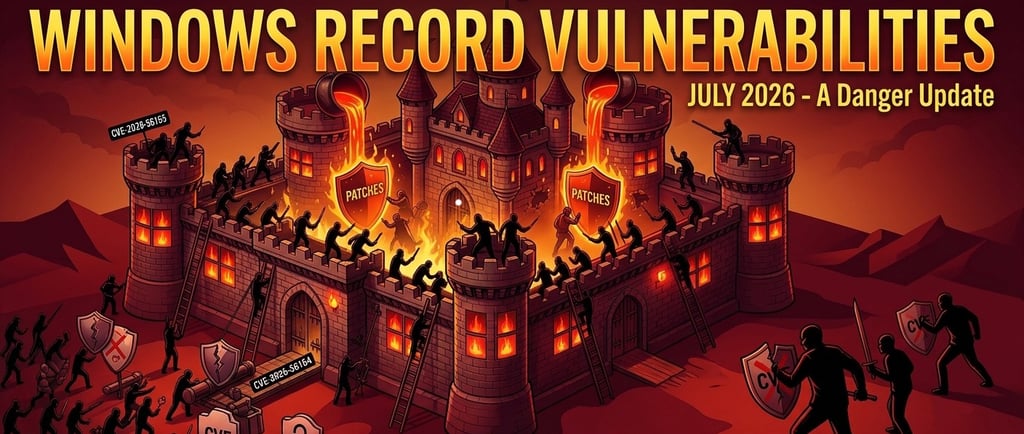
If you're running a Windows machine, July 2026 has been a rough month. Microsoft just dropped a record-breaking number of security updates – over 570 vulnerabilities fixed in a single Patch Tuesday release. And there's a clear reason behind it: AI has changed the game.
Ilie Lucian - Founder & CyberSecurity Engineer, Videographer, Web Designer, SEO
7/24/20262 min read
What Happened in July
To put things in perspective: 622 vulnerabilities in total, 416 of them affecting Windows directly. 59 are rated critical, and 48 can be exploited remotely. That's a staggering number that reflects how complex the threat landscape has become.
Among the most concerning issues:
BitLocker (CVE-2026-50661): An attacker with physical access to your machine can bypass encryption and access your data. It's not a remote attack, but it's a serious flaw if someone gets their hands on your device.
SharePoint (CVE-2026-56164): This one is actively being exploited to escalate privileges. It requires network access, but it's particularly dangerous for businesses using SharePoint internally.
Active Directory Federation Services (CVE-2026-56155): Another actively exploited vulnerability that allows privilege escalation.
Microsoft Defender (CVE-2026-33825): A zero-day that gives a local attacker full system control.
Desktop Window Manager (CVE-2026-20805): Actively exploited to bypass the ASLR security mechanism.
What Are Zero-Days and Why Should You Care?
Zero-day vulnerabilities are the ones security researchers lose sleep over. They're discovered before the vendor has time to patch them, leaving systems exposed. This month, Microsoft fixed three of them.
But it doesn't stop there. A researcher going by "Nightmare Eclipse" released another zero-day immediately after Patch Tuesday. Called LegacyHive, it's a vulnerability in the User Profile Service that lets any non-admin user take over the system. No CVE assigned yet, no official patch. There are unofficial micropatches available, but it's a reminder that attackers don't wait for Patch Tuesday.
Why Is This Happening Now?
The explanation is simpler than you'd think: AI has democratized vulnerability discovery. AI tools help both defenders and attackers find more vulnerabilities faster. The result? An explosive number of reported vulnerabilities, and an explosive number of patches to release.
One researcher has already published nine unpatch zero-days in recent months, targeting components like Microsoft Defender, BitLocker, and other critical parts of the Windows ecosystem. It's a race between discovery and repair.
What You Can Do
You don't need to be a security expert to protect yourself. Here are a few simple steps:
Install the updates immediately – The July patches (KB5101650 for Windows 11) fix most of the issues. Don't postpone them.
Restrict local access – Many vulnerabilities require an attacker to already have some level of access. Limiting accounts and removing unnecessary users reduces risk.
Enable an EDR solution – Endpoint Detection and Response tools can monitor suspicious behavior, especially from sensitive processes.
Check your Windows version – CVE-2026-50458 affects Windows 11 24H2, 25H2, and 26H1, as well as Server 2025. Make sure you're running the correct builds.
Microsoft and CISA are both urging immediate application of these patches. It's not a drill.
If You Do Nothing Else
The best defence is to patch your system and stay informed. This month's update record shows that cybersecurity is no longer a static field. AI is accelerating everything – attacks, discoveries, and defences. The key to staying safe is to keep up.
1Cyber Agency
Easy build a website for your business
© 2026 1Cyber Agency-Hardened code and flat-rate packages.
ZERO-TRUST DIGITAL DEPLOYMENTS